Diamond Head Hike Guide 2026: Everything You Need to Know Before You Go

The first time I saw Diamond Head, I was standing on Waikiki Beach at 5:30 AM, coffee in hand, watching the sun rise behind that huge volcanic crater. I remember thinking, “That’s a mountain?” It looked more like a giant sleeping dragon curled up next to the ocean. Three hours later, I was standing on top of it, sweaty, out of breath, and staring at the best view I have ever seen in my life.
If you are planning a trip to Oahu, chances are Diamond Head is already on your list. But here is the problem. Most guides online copy the same five facts from each other. They tell you the distance. They tell you the fee. Then they stop. They don’t tell you what it actually feels like to stand in that tunnel with no lights, or why the reservation system trips up so many first-time visitors, or what to do near Diamond Head after your hike is done.
This guide covers all of it. Real trail details from hikers who did it in 2026. The newest reservation rules and prices. The best time to go. What’s near Diamond Head (the market, the grill, the beach park, and more). And a few honest answers to questions every visitor asks before booking. By the end, you will know more about Diamond Head than most people who have already been there.
What Is Diamond Head?
Diamond Head is a volcanic crater on the island of Oahu, Hawaii, sitting right at the edge of Waikiki. Locals call it Lēʻahi. The crater formed around 300,000 years ago from a single volcanic eruption. It has been dormant for roughly 150,000 years, so no, it is not going to erupt while you are hiking it.
British sailors gave it the name “Diamond Head” in the 1800s. They spotted calcite crystals sparkling on the crater’s slopes and mistook them for diamonds. There were no diamonds. But the name stuck, and now it is one of the most photographed landmarks in the Pacific.
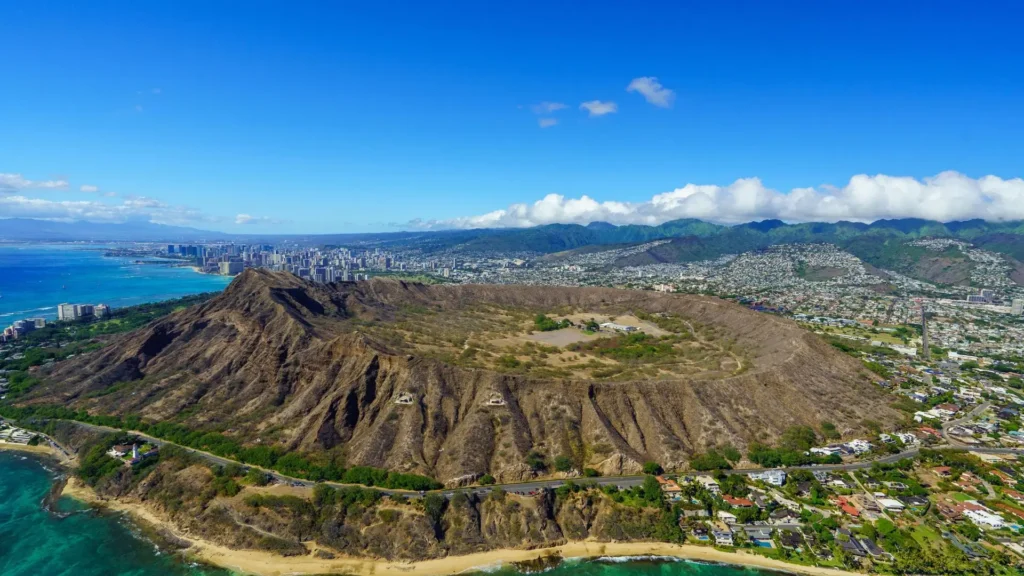
Today, Diamond Head is a Hawaii State Monument and a U.S. National Natural Landmark. It sits inside a state park managed by Hawaii’s Department of Land and Natural Resources (DLNR). Visitors come for one main reason: the hike to the summit, and the view waiting at the top.
Is Diamond Head a Beginner Hike?
Yes, mostly. Diamond Head is one of the friendliest hikes in Hawaii for beginners, families, and people who don’t hike often. You don’t need special gear, ropes, or hiking experience.
That said, it is not a flat walk in the park either. The trail starts easy on a paved path, but it turns into uneven dirt and loose rock about halfway up. Near the top, you will climb steep concrete stairs, pass through a dark tunnel, and go up a tight spiral staircase inside an old military structure. None of it is technical or dangerous if you take your time, but it will get your heart rate up.
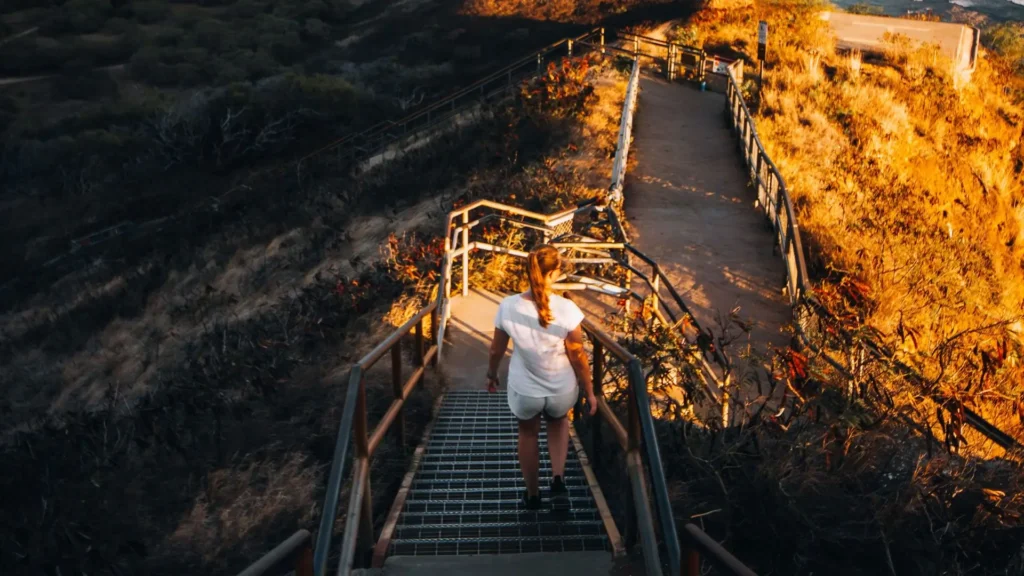
My honest advice: if you can walk up ten flights of stairs without stopping, you can do this hike. If stairs and heat wear you out quickly, plan for extra time and rest at the lookout points along the way. Kids as young as five and grandparents in their seventies do this trail every single day.
How Long Does the Diamond Head Hike Take?
Most people finish the round trip in 1.5 to 2 hours, including stops for photos and water breaks. The trail itself is short: 1.6 miles (2.6 km) round trip, with 0.8 miles one way from the trailhead to the summit.
Here is a rough breakdown based on typical hiking speed:
- Up to the summit: 40 to 60 minutes
- Time at the top (photos, views, catching your breath): 15 to 20 minutes
- Back down: 30 to 40 minutes
If you are very fit and skip the photo stops, you can do the whole thing in under an hour. If you’re hiking with young kids, older family members, or you stop often for pictures, budget closer to 2.5 hours. Either way, this is a half-morning activity, not an all-day trek.
Diamond Head Hike: Trail Difficulty and What to Expect
The trail is officially rated moderate. It’s not a hard hike, but it also isn’t effortless, especially in Hawaii’s heat. Here is what the trail actually looks like, section by section:
The start: A smooth, paved path through low, scrubby forest. Easy walking, gentle incline.
The middle: The path turns to dirt and loose gravel. It gets steeper here, and there is very little shade. This is where most people start to feel the sun.
The switchbacks: A set of zig-zagging stairs that climb sharply. There’s a lookout point about halfway up with a great view and a good place to catch your breath.
The tunnel: A short, unlit tunnel carved into the crater wall. Bring your phone flashlight. It’s dark, a little eerie, and honestly one of the most memorable parts of the hike.
The final stairs: Two staircases near the summit. One set is a narrow spiral staircase inside an old Fire Control Station built in 1911. It’s tight, so expect some waiting if it’s busy.
The summit: A 360-degree view of Waikiki, Honolulu, the Koʻolau mountains, and the Pacific Ocean. On a clear day, you can see the island of Molokaʻi about 25 miles away.
The elevation gain is 560 feet (171 meters), reaching a summit height of 761 feet (232 meters). The trail is very exposed with almost no shade, so the heat matters more than the distance.
Diamond Head Reservations and Fees (2026 Update)
This is where most first-time visitors get confused, so let’s clear it up. Since 2022, Diamond Head State Monument requires an advance online reservation for every non-resident visitor. Walk-ups are not allowed. If you show up without a booking, you will be turned away at the gate.
Where to book: The only official site is gostateparks.hawaii.gov. Third-party sites often charge extra fees, and some aren’t affiliated with the state at all, so book direct if you can.
How far in advance: Reservations open exactly 30 days before your visit date, at midnight Hawaii time. Sunrise slots (6:00 to 7:00 AM) usually sell out within hours, so set a reminder if you want an early start.
2026 Pricing:
| Fee Type | Cost |
|---|---|
| Non-resident entry (per person) | $5 |
| Non-resident vehicle parking | $10 |
| Children age 3 and under | Free |
| Hawaii residents (with valid ID) | Free, no reservation needed |
A couple driving in pays $20 total ($10 for two people plus $10 parking). A family of four pays $30 total.
Time slots: Vehicle parking reservations run in 2-hour blocks starting at 6:00 AM. Walk-in and drop-off visitors get 1-hour entry slots. You must arrive within the first 30 minutes of your booked slot, or you risk losing your spot. The last entry is at 4:00 PM, and gates lock at 6:00 PM sharp.
Cancellations: You can change or cancel up to the day before your visit, subject to a small cancellation fee. Refunds for lower-cost changes are only given if requested three or more days before your entry date.
One detail that catches people off guard: if you’re visiting Diamond Head with a Hawaii resident friend or family member, you are not exempt from the fee just because they are. Only the resident enters free; everyone else in the group still needs a paid reservation.
If you’re renting a car for your trip, it’s worth reading our Oahu parking tips guide before you go, since parking rules around Diamond Head and Waikiki can be confusing for first-time visitors.
Best Time to Hike Diamond Head
Early morning is the best time, hands down. Gates open at 6:00 AM, and hiking at sunrise means cooler temperatures, softer light for photos, and smaller crowds. The trail has almost no shade, so by mid-morning in summer, it can get genuinely hot.

Late afternoon, roughly two to three hours before the 6:00 PM gate closing, is the second-best option. The sun is lower, the heat has eased off, and you can catch golden-hour views over Waikiki on the way down.
Avoid midday if you can, especially between 11 AM and 2 PM. That’s when the trail is busiest, hottest, and most crowded near the summit stairs and tunnel.
If sunrise hikes are your thing, check out our list of the best places to watch sunrise in Oahu to see how Diamond Head compares with other spots on the island.
Diamond Head and Waikiki: The View You Came For
One of the biggest reasons people hike Diamond Head is the view of Waikiki from the summit. From the crater rim, you get a full sweep of Waikiki’s beach and hotel skyline, with the Pacific Ocean stretching out behind it. It’s the postcard shot of Oahu, and no photo really does it justice in person.
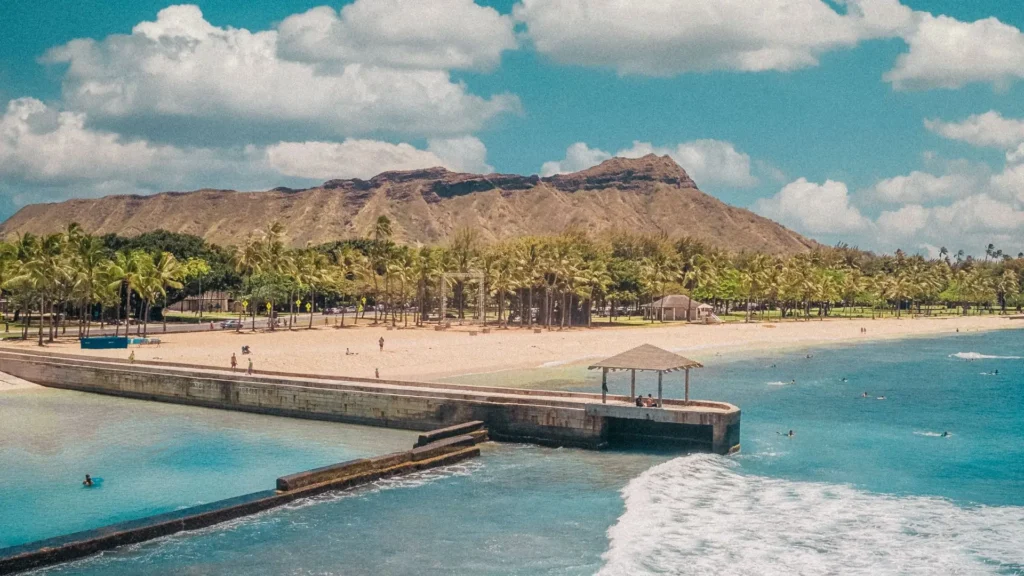
The reverse view matters too. If you’re staying in Waikiki, look toward the east in the early morning or evening, and you’ll see Diamond Head’s silhouette rising over the coastline. It’s one of the most recognizable shapes in the Pacific, and it’s a good reference point for getting your bearings anywhere in Waikiki or Honolulu. For more on the beach itself, see our guide to Waikiki Beach.
Diamond Head Lighthouse and Road Vista Point
Just below the crater, on Diamond Head Road, sits the Diamond Head Lighthouse. It’s a small, still-active lighthouse built in 1917, and while you can’t go inside, you can view it from the road or from a designated lookout area nearby.
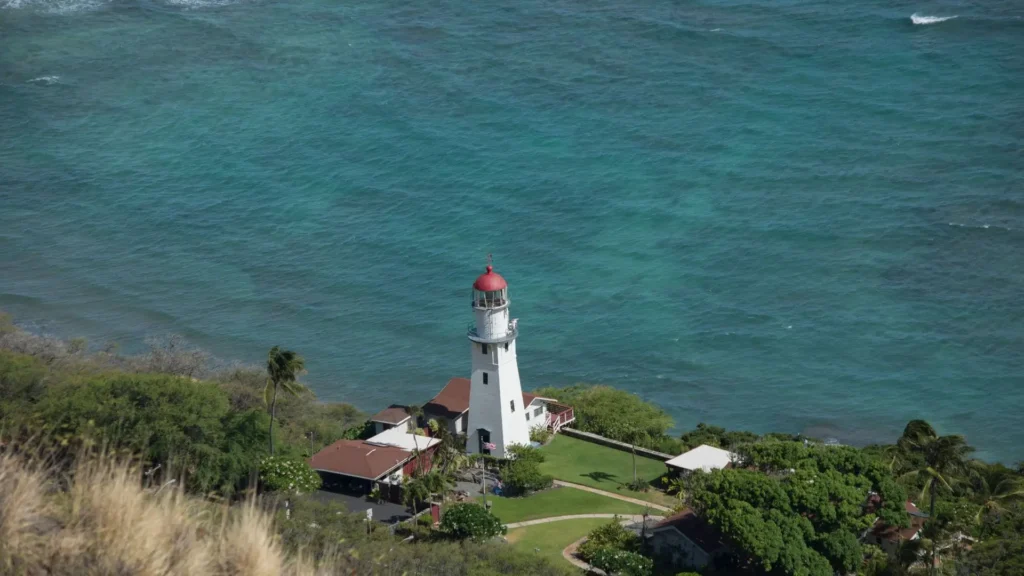
Right next to it is the Diamond Head Road Vista Point, a small pullout with sweeping ocean views and a great angle of the lighthouse against the cliffs. It’s a nice, low-effort stop if you’re driving around the south shore and want a break from the crowds at the main hiking entrance. Sunrise and sunset both work well here, and it’s usually far quieter than the summit trail.
Where to Eat Near Diamond Head
After a sweaty hike, food is usually the first thing on everyone’s mind. A few local spots near the monument are worth knowing about:
Diamond Head Market & Grill is the most popular stop by far. It’s part deli, part bakery, part plate-lunch counter, and it sits just minutes from the trailhead. Locals and tourists both line up here for their guava chiffon cake and loco moco.
Diamond Head General Store is a smaller, low-key spot for grab-and-go snacks, drinks, and quick breakfast items if you want to fuel up before the hike rather than after.
If you’re looking for a Diamond Head restaurant with a sit-down feel rather than a counter-service one, the surrounding Kaimuki and Monsarrat Avenue neighborhoods (right next to the monument) have a solid mix of cafes, poke spots, and casual dining. For more budget-friendly options nearby, our roundup of cheap eats in Honolulu is worth a look before you head out.
Diamond Head Beach Park
Diamond Head Beach Park sits at the base of the crater, right along the coast. It’s smaller and less crowded than Waikiki Beach, with rockier shoreline in places, but it’s a favorite for surfers and sunset watchers. If you want to cool off after your hike or just watch the waves without fighting for beach space, this is a quieter alternative close by, and it fits well on our list of least crowded beaches in Oahu.
Diamond Head Tennis Center and Nearby Apartments
The Diamond Head Tennis Center, located in the same general area, offers public courts for visitors and locals who want to fit in a game during their stay. It’s a nice, low-key option if you’re staying nearby and want some activity beyond hiking.
Diamond Head is also a real neighborhood, not just a park. There are Diamond Head apartments and homes along the crater’s base and up toward Diamond Head Road, and it’s considered one of the more desirable residential pockets of Honolulu thanks to the views and proximity to Waikiki.
Diamond Head Luau and Diamond Head Theatre
If you want a taste of Hawaiian culture beyond the hike, a Diamond Head luau brings together traditional food, music, and dance, usually held at venues near the south shore rather than on the crater itself. It’s a popular add-on for visitors spending a full day in the area.
For something different, the Diamond Head Theatre, located in the Kaimuki neighborhood near the crater, is one of Oahu’s oldest community theatres, running live performances year-round. It’s worth checking their schedule if you’re staying in the area for more than a day or two.
Is Diamond Head Oahu Worth It?
Yes. Out of everything I did on Oahu, Diamond Head is one of the few things that genuinely lived up to the hype. It’s short enough to fit into any schedule, easy enough for almost anyone to complete, and the view at the top is one of the best in Hawaii, if not the best.
It’s not a hidden gem. It will be busy, especially at sunrise and on weekends. But the crowd doesn’t ruin the experience the way it can at other over-touristed spots. The trail moves people along steadily, and once you’re standing on that summit looking out over Waikiki and the Pacific, the crowd fades into the background.
If you only have time for one hike on Oahu, make it this one. If you have a bit more time and want to compare it with another popular climb, check out our full guide to the best hikes on Oahu, including how Diamond Head stacks up against trails like Koko Head.
Other Things Called “Diamond Head” (Quick Answers)
A few people search for “Diamond Head” looking for something other than the Hawaii crater. Quick answers, so you can find what you actually need:
- Diamond Head (the band): A British heavy metal band formed in 1976, known for influencing later metal acts. Guitarist Brian Tatler co-founded the band and still performs with it today.
- Diamondhead in Ben 10: Diamondhead is one of Ben Tennyson’s alien forms, a crystalline being from the planet Petropia with a body harder than diamond.
- Diamond Clean toothbrush heads: Replacement heads for Oral-B’s Diamond Clean electric toothbrush line, sold separately from the handle.
- Black diamond head torch/flashlight: A style of rugged, high-lumen flashlight, unrelated to the Hawaii landmark, often marketed for outdoor or tactical use.
- Diamond head shape: In jewelry and cutting terms, a diamond-shaped head refers to a rhombus-style cut or design, used in gemstones and some tools.
None of these connect to the Hawaii hiking trail, but if you landed here by mistake, hopefully this saves you a second search.
Final Thoughts
Diamond Head earns its reputation. It’s short, it’s accessible, and it rewards you with one of the best views in the Pacific for very little effort compared to other hikes in Hawaii. Book your reservation early, start at sunrise if you can, bring water, and give yourself a couple of hours to enjoy it properly, including a stop at Diamond Head Market & Grill afterward. It’s a small piece of your trip that ends up being one of the biggest highlights.
Frequently Asked Questions
The round trip is 1.6 miles (2.6 km), and most people complete it in 1.5 to 2 hours, including stops.
Yes, if you’re not a Hawaii resident. Reservations open 30 days in advance through gostateparks.hawaii.gov and are required for both entry and parking.
Yes. The gate opens at 6:00 AM, and sunrise slots are some of the most popular bookings of the day. Bring a flashlight since the lower trail is still dark at opening.
Generally yes. Many families hike it with young children. Just supervise them closely near the stairs, the tunnel, and the summit railings.
Water, sunscreen, a hat, comfortable closed-toe shoes, and a phone flashlight for the tunnel section. There is very little shade on the trail.
Yes, but non-residents need a separate paid parking reservation ($10 per vehicle) in addition to their entry fee.