Punchbowl Cemetery Oahu: The Complete 2026 Visitor Guide

Yes, you can visit Punchbowl Cemetery. It is free, open every day, and no reservation is needed. Punchbowl Cemetery — officially the National Memorial Cemetery of the Pacific — sits inside an extinct volcanic crater above downtown Honolulu. More than 5 million people visit each year to see the graves of over 61,000 veterans and family members, walk the crater rim for sweeping views of Honolulu, and pay quiet respect at one of Hawaii’s most meaningful historic sites.
This guide covers the 2026 hours, the visitor map, the rules tour buses must follow, who can be buried there, and the famous people resting on this hillside — everything you need before you go.
What Is Punchbowl Cemetery?
The National Memorial Cemetery of the Pacific is the formal name. Most locals and visitors just call it Punchbowl Cemetery, the Punch Bowl Cemetery, or Oahu Punchbowl Cemetery. It is a United States national cemetery, and the National Cemetery Administration (part of the Department of Veterans Affairs) runs it.
The site opened to the public on July 19, 1949. The first burial happened a few months earlier, on January 4, 1949. Today it holds the remains of service members from World War I, World War II, the Korean War, and the Vietnam War, along with their eligible family members. In 1976, the cemetery earned a spot on the National Register of Historic Places.
People also search for it as the National Memorial of the Pacific at Punchbowl, Punchbowl National Cemetery, or simply the Punchbowl. They all point to the same place.
Can You Visit the Punchbowl Cemetery?
Yes. The cemetery is open to the public every single day, and there is no cost to enter. You do not need a ticket, a permit, or a booking of any kind for a self-guided visit. Bring your car, a rideshare, or join a tour that stops there.
There is one rule to know. Tour buses and vans that stop at Punchbowl are not allowed to let passengers out of the vehicle. If you join a Pearl Harbor or circle-island tour that includes Punchbowl, expect a slow drive-through with narration, not a walking stop. If you want to walk the grounds, visit the memorial courts, or take photos up close, you need to come on your own by car or rideshare, or join a small private tour built specifically for a walking visit.
Understanding the Punchbowl Crater
The cemetery sits inside the Punchbowl Crater, a tuff cone that formed roughly 75,000 to 100,000 years ago during a later stage of volcanic activity on Oahu. Lava met old coral reef and cracked through it, leaving this bowl-shaped crater behind. That bowl shape is where the English name “Punchbowl” comes from.
Native Hawaiians called it Puowaina, which translates to “Hill of Sacrifice.” Long before it became a cemetery, the crater was used as an altar for offerings and as a site tied to the old kapu system of sacred laws. Later, during the reign of Kamehameha the Great, cannons were placed on the rim to salute important arrivals. In the 1930s, the Hawaii National Guard even used it as a rifle range.
That long, layered history is part of what makes the crater more than scenery — it carries meaning that predates the cemetery itself by centuries.
Is the Punchbowl Crater Worth Visiting?
Short answer: yes, and for more than one reason. The crater rim gives you one of the best free viewpoints of Honolulu on the island — you can see the skyline, Diamond Head in the distance, and the ocean beyond the harbor. Sunrise and late afternoon are the best times for this view, when the light is soft and the crowds are thin.
Beyond the view, the crater floor holds wide green lawns, rows of flat marble markers, and the Honolulu Memorial with its carved maps of Pacific battles. It is quiet in a way few places in Waikiki are. If you only have time for one non-beach stop in Honolulu, Punchbowl gives you history, a free view, and a peaceful break from the resort strip in a single visit.
Why People Choose Oahu Punchbowl Cemetery Tours
Travelers add Punchbowl Cemetery tours to their Oahu plans for a few clear reasons:
- To understand America’s role in the Pacific during WWII, Korea, and Vietnam
- To pay respect to service members, including relatives for some visitors
- To find a calm, reflective break from beaches and shopping
- To see one of Oahu’s best free viewpoints without a hike
- To pair it naturally with a Pearl Harbor trip, since both sites cover the same era
Are There Guided Tours, or Is It Self-Guided?
The National Cemetery Administration does not run its own guided tours. Most Punchbowl Cemetery tours in Oahu are self-guided walks, and that is by design — the site is a working cemetery first, a memorial second, and a tourist stop third.
That said, you have three real ways to experience it:
- Self-guided visit. Drive or rideshare in, park for free, and walk the grounds at your own pace. This gives you the most time at the Honolulu Memorial and the scenic lookout.
- Drive-through as part of a larger tour. Many Pearl Harbor and Oahu circle-island tours include Punchbowl as a stop on the way back to Waikiki. Remember, guests stay in the vehicle for these.
- Small private or custom tours. A few local operators offer walking time at Punchbowl paired with nearby historic stops like Iolani Palace or the Kamehameha Statue, with a guide narrating the history as you walk.
If you want to actually walk the memorial courts and read the mosaic battle maps, plan a self-guided visit or a private walking tour rather than relying on a big-bus stop.
Using the Punchbowl Cemetery Map
The cemetery gives visitors a printed map at the Administration Building near the entrance, and a kiosk on-site can help you locate a specific grave by name. The map lays out:
- The central boulevard and flagpole plaza at the entrance
- Burial sections (marked by letter, such as Section A, Section D, Section W)
- The columbarium courts for cremated remains
- The memorial pathway lined with donated monuments
- The staircase up to the Honolulu Memorial and the scenic overlook
Following the map in order — entrance, boulevard, burial sections, then the staircase to the memorial — is the easiest way to see everything without backtracking.
What You Will See During Your Visit
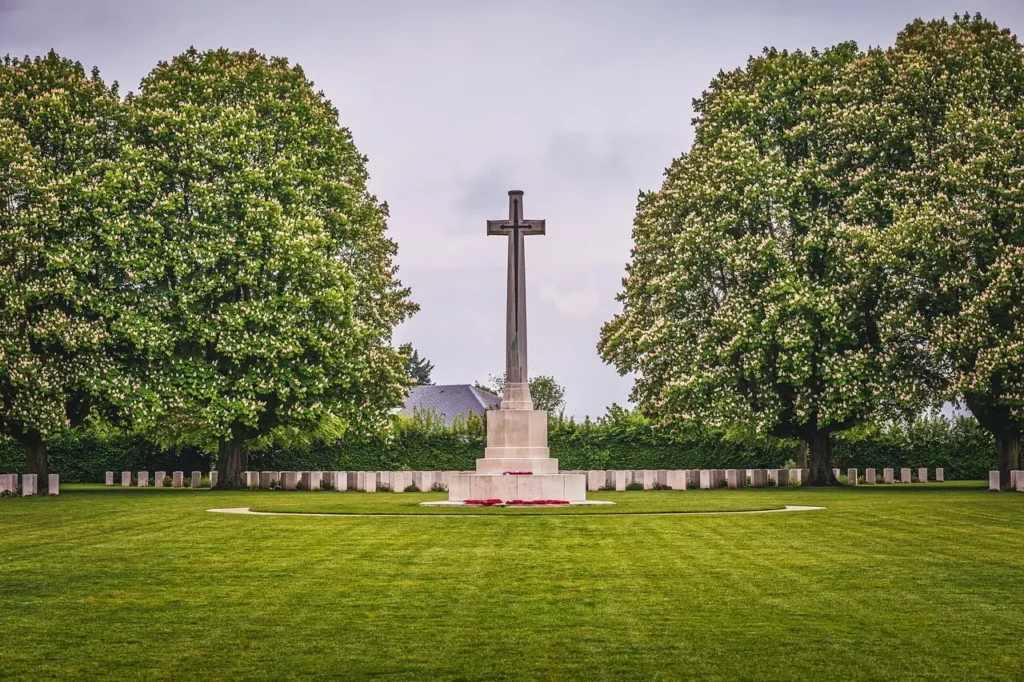
Walking in, you will notice how uniform everything looks. Flat marble markers lie flush with the grass in long, even rows — a design meant to represent equality in service, no matter a person’s rank. There are no upright headstones crowding the view, which is part of why the crater feels so open and calm.

At the western end of the central boulevard, a grand staircase leads up to the Honolulu Memorial. On either side of the stairs, eight Courts of the Missing list more than 18,000 names of Americans missing from the WWII Pacific campaign and over 8,000 missing from the Korean War.
Two additional half-courts hold the names of over 2,500 Americans missing from Vietnam. At the top, a small chapel sits flanked by galleries with mosaic maps showing major battles across the Pacific and Korea. These displays are educational, not dramatic — dates, unit names, and troop movements, presented plainly.
Punchbowl Cemetery Hours and Entry Information (2026)
Here is the current, official information from the National Cemetery Administration:
- Visitation hours: Daily, 8:00 a.m. to 6:00 p.m.
- Office hours: Monday through Friday, 8:00 a.m. to 4:30 p.m. Closed on federal holidays, except it stays open for Memorial Day.
- Entry fee: Free, always
- Reservations: Not required for a self-guided visit
- Address: 2177 Puowaina Drive, Honolulu, HI 96813
- Phone: 808-532-3720
- Parking: Free, on-site
- Kiosk: Yes, available near the entrance to help locate specific gravesites
A safety project that replaced cracked concrete walkways in Columbarium Courts 1–5 ran from mid-2024 through October 2025. That work is now finished, and those courts are fully open again. It’s still worth checking the cemetery’s official page or Facebook page before a special trip, in case of short-term closures around ceremonies or maintenance.
Best Time to Visit Punchbowl Cemetery
Early morning, right after the 8:00 a.m. opening, and late afternoon before the 6:00 p.m. close are the best windows. Both offer cooler air and softer light for photos at the crater rim. Weekdays are noticeably quieter than weekends. If silence matters to you, skip Memorial Day and major ceremony dates, since the grounds fill with visitors and official programs on those days.
Punchbowl Cemetery Memorial Day Experience
Memorial Day at Punchbowl is one of the most significant events held there each year. The National Cemetery Administration hosts a public ceremony with wreath-laying and remarks, and thousands of visitors and families attend. Office hours extend on this day specifically to support the crowd.
Expect heavier traffic on Puowaina Drive and limited parking if you plan to attend. Arrive early, follow posted directions from staff and volunteers, and keep in mind this day is first about honoring the deceased, not sightseeing.
Visitor Etiquette You Must Follow
Punchbowl is an active national cemetery, not a park. A short list of etiquette basics keeps the visit respectful for everyone:
- Speak quietly, especially near burial sections
- Dress modestly and comfortably
- Avoid loud music or phone calls
- Never walk directly on top of a grave
- Watch children closely near markers and slopes
- Leave items exactly as posted rules describe (more on this below)
Photography Rules at Punchbowl Cemetery
Photography is allowed, including for personal and family memories, but a few limits apply. Do not photograph funerals, active services, or grieving families without permission. Drones are not permitted anywhere on the grounds. Commercial photography or filming needs prior official approval. Keep your visit low-key: this is a place of honor first, and a scenic backdrop second.
Floral and Grounds Rules Most Guides Skip
This is a detail most Punchbowl guides leave out, and it matters if you’re bringing flowers for a family grave. Fresh-cut flowers in metal containers (not glass) are allowed at any time. Staff sweep the entire cemetery of flowers every Friday to keep the grounds tidy, so weekend or early-week placement lasts longest.
Potted plants and artificial flowers are only allowed for the ten days around Christmas. Permanent plantings, statues, glass items, balloons, wind chimes, and stuffed toys are not permitted on any gravesite. Personal in-ground flower vases are no longer being installed, and families are responsible for maintaining any existing vase themselves.
Firearms and other weapons are prohibited anywhere on the property under federal regulation, with an exception only for official military honors.
How Long Does a Visit Take?
Most visitors spend 45 to 90 minutes at Punchbowl. That is enough time to park, walk the boulevard, climb to the Honolulu Memorial, read a few of the mosaic maps, and take in the view from the rim. Add extra time if you’re searching for a specific family grave using the kiosk, since locating a single site among tens of thousands can take a few extra minutes.
Accessibility for Visitors
The main boulevard and memorial walkways are paved and wheelchair accessible. Designated accessible parking is available near the Administration Building. Because the cemetery sits inside a crater, some paths toward the upper burial sections and the memorial staircase involve a gradual slope, so visitors with mobility needs may want assistance for the longer walks.
Is Punchbowl Cemetery Suitable for Children?
Children can visit, and many families do. It helps to explain beforehand why the site matters and why quiet, respectful behavior is expected.

Older kids and teens often get real educational value here, especially if they’re studying WWII, Korea, or Vietnam in school — the mosaic maps and Courts of the Missing turn textbook history into something they can stand in front of.
Can Anyone Be Buried at the Punchbowl Cemetery?
No, not anyone. Burial at Punchbowl follows federal eligibility rules for VA national cemeteries. In general, eligible groups include:
- Veterans and service members discharged under conditions other than dishonorable, who met minimum active-duty service requirements
- Spouses and widows or widowers of eligible veterans
- Minor dependent children, and in some cases unmarried adult children with disabilities
- Certain reserve component members who died on active duty or training duty, or who were eligible for retired pay
There’s an important space issue worth knowing in 2026: Punchbowl has been functionally closed to new in-ground casket burials since 1991, though it can still accommodate a casket in an existing family gravesite. Cremated remains can still go into the columbarium, but current projections show that space for cremated remains running out by around 2036.
Because of this, Hawaii’s congressional delegation introduced the Hawaii National Cemetery Act in January 2026 to require the VA to build a second national cemetery in Hawaii, since Punchbowl remains the state’s only one. If you’re planning ahead for a veteran’s burial, contact the cemetery directly to confirm current space availability — availability can change based on disinterments and other factors.
Notable People Buried at Punchbowl
Few cemeteries in the country mix military heroism with names people recognize from very different walks of life. A short list of who rests here:
- Ernie Pyle, the WWII war correspondent killed by sniper fire on Ie Shima, was buried here on the cemetery’s opening day in 1949.
- Daniel K. Inouye, Medal of Honor recipient and long-serving U.S. Senator from Hawaii.
- Ellison Onizuka, NASA astronaut and one of seven crew members lost in the 1986 Challenger disaster.
- Patsy Mink, the first woman of color elected to Congress and a key figure behind Title IX.
- John A. Burns, former Governor of Hawaii.
- Norman Keith Collins, known worldwide as “Sailor Jerry,” the tattoo artist who helped shape modern American tattoo culture.
- Multiple Medal of Honor recipients from WWII, Korea, and Vietnam, including several Japanese-American soldiers of the 100th Infantry Battalion and 442nd Infantry Regiment whose awards were upgraded decades after their service.
Seeing these names on a cemetery map — an astronaut, a senator, a tattoo legend, and dozens of Medal of Honor recipients sharing the same hillside — is part of what makes a visit here feel different from any other stop in Honolulu.
Punchbowl Cemetery Compared to Other Cemeteries in Honolulu, HI
Among cemeteries in Honolulu, HI, Punchbowl stands apart because it’s a federal military cemetery, not a private or religious one. It exists purely for remembrance, service eligibility, and education — not for general public burial.
Diamond Head Memorial Park Cemetery is a separate, privately operated cemetery near the Diamond Head crater, established in 1936. It’s a 25-acre mortuary and burial ground open to the general public, unrelated to military eligibility rules. If your search brought you here looking for burial or funeral services rather than a historic visit, Diamond Head Memorial Park Cemetery — not Punchbowl — is the right place to contact.
Pearl Cemetery, sometimes confused with Punchbowl in search results, is also a distinct site serving a different community. Each of these cemeteries deserves its own respectful, separate visit rather than being lumped together.
The Plaza at Punchbowl, Honolulu HI: Not the Cemetery
One quick clarification, since the names overlap in search results: The Plaza at Punchbowl, located at 918 Lunalilo Street in Honolulu, is a senior living community offering independent living, assisted living, and memory care. It sits on the slopes near Punchbowl Crater, close to the National Memorial Cemetery of the Pacific, but it is a residence for seniors, not a cemetery or burial site. If you were searching for elder care near Punchbowl, that’s the property you want — for the historic cemetery and memorial itself, use the information in this guide.
Getting to Punchbowl Cemetery
Punchbowl sits in central Honolulu, roughly midway between the airport and Waikiki, about 15 to 20 minutes by car from Waikiki depending on traffic. From the H-1 freeway, take exit 21A toward Pali Highway, follow signs onto School Street, then Lusitana Street, and finally Puowaina Drive, which leads directly to the cemetery gate. Free parking is available inside the grounds, and rideshare drivers can drop passengers near the main entrance.
Planning Punchbowl Cemetery Tours the Right Way
Good planning turns a rushed stop into a meaningful one:
- Check the 8:00 a.m. to 6:00 p.m. hours before you go, especially around federal holidays
- Bring water and wear comfortable shoes for the walk up to the memorial
- Dress modestly, and plan for a little extra time if you’re locating a specific family grave
- If you also want Pearl Harbor on the same day, check current Pearl Harbor ticket and reservation details ahead of time, since that site does require advance booking, unlike Punchbowl
- Build it into a broader day plan — Punchbowl pairs naturally with other things to do in Oahu around downtown Honolulu
Why Punchbowl Cemetery Still Matters in 2026
Punchbowl connects modern visitors to a real historical cost. With the site closed to new in-ground burials since 1991, cremated-remains space projected to run out by 2036, and a 2026 congressional bill now pushing for a second national cemetery in Hawaii, Punchbowl is at a genuine turning point in its own story. Visiting now means seeing a living memorial that is still actively part of a national conversation about how America honors its veterans — not just a historic site frozen in the past.
If you’re building out a full Oahu itinerary around historic and cultural stops, it’s worth checking a weekend Oahu itinerary to see how Punchbowl, Pearl Harbor, and downtown Honolulu can fit into the same day or two without feeling rushed. Comparing it against a stop at the Diamond Head crater and trail also helps first-time visitors understand how the two very differently named “Diamond Head” sites — the hiking trail and the separate memorial park cemetery — fit into a Honolulu day.
Final Thoughts on Punchbowl Cemetery Tours in Oahu
Punchbowl Cemetery tours in Oahu offer far more than a photo stop. They offer real history, quiet reflection, and one of the best free views in Honolulu, all in under two hours. Whether you’re here to trace a family name, learn about the Pacific war, or simply find a calm break between beach days, this hillside crater deserves a real place in your Oahu plan — not just a five-minute drive-through on the way back to Waikiki. For more help planning the rest of your stay, this first-time Oahu visitor guide is a good next stop.
Frequently Asked Questions
No. Entry is free every day, and no ticket or reservation is required for a self-guided visit.
The cemetery is open daily from 8:00 a.m. to 6:00 p.m. The administration office is open weekdays, 8:00 a.m. to 4:30 p.m., closed on federal holidays except Memorial Day.
Tour vehicles can drive through, but passengers must stay inside the vehicle. No tour bus is allowed to let guests out to walk the grounds.
Yes. The crater rim is a free scenic viewpoint over Honolulu, and the grounds themselves are peaceful even for visitors mainly there for the view.
No. Burial is limited to eligible veterans, their spouses, and qualifying dependents under federal rules, and in-ground casket space has been closed since 1991 except for existing family gravesites.
No. Diamond Head Memorial Park Cemetery is a separate, privately run cemetery near Diamond Head, open to the general public, unrelated to military burial eligibility.
No. The Plaza at Punchbowl is a senior living community near Punchbowl Crater, not connected to the National Memorial Cemetery of the Pacific.